
Cumberland County Criminal Court Cases
North Carolina uses one General Court of Justice and one local clerk structure. Cumberland County Superior Court hears felony trials. District Court hears misdemeanors, traffic matters, and the first stages of felony cases. Both divisions sit in Judicial District 14, and the elected Clerk of Superior Court keeps their criminal files. That shared custodian matters. A searcher does not need to choose between separate county and district clerks, but must still identify the correct court division and case number.
A felony can begin before a magistrate and in District Court before an indictment sends it to Superior Court. A District Court misdemeanor may return to Superior Court on an appeal for a new trial, called a trial de novo. The court file records the prosecution. Police reports and booking records remain with their creating agencies. Review the broader Cumberland County arrest lookup when the goal is the custody event rather than the filed case.
Cumberland Court Divisions at Dick Street
The local court divisions share the Judge E. Maurice Braswell Cumberland County Courthouse, yet their work is not interchangeable. The official Cumberland court directory identifies services and current contacts for the site. Magistrates handle warrants, initial process, and release conditions. District Court manages misdemeanor cases and early felony proceedings. Superior Court conducts felony trials and keeps the related record through the clerk.
| Court or Office | Criminal Case Role | Phone |
|---|---|---|
| Superior Court Division | Felony trials and related files | Judges 910-475-3016; clerk 910-475-3000 |
| District Court Division | Misdemeanors, traffic, and first felony stages | Judges 910-475-3012; clerk 910-475-3000 |
| Magistrates | Initial process, warrants, and release terms | 910-475-3600 or 910-475-3038 |
| District Attorney | Charging and adult prosecution | 910-475-3010 |
The clerk, not the prosecutor, is the main custodian for the public case file. The District Attorney can answer questions tied to its own prosecutorial role but does not replace the clerk's record counter.
Searching Cumberland County Case Records
The North Carolina eCourts Portal is the main remote entry point. All 100 counties have used eCourts since October 13, 2025. Narrow the location to Cumberland County and use the most exact locator available. A complete file number is stronger than a name. When a name search produces a likely match, compare the court division, dates, status, and file number before treating it as the intended case.
- Open public Portal and choose the person, case-number, or citation-number path that fits the information in hand.
- Select Cumberland County when the interface offers a location filter.
- Enter the narrowest reliable identifier, using full legal spelling for a person search or the exact file number when known.
- Open the detail and review each charge, event, hearing, status, and disposition separately.
- Use the courthouse terminal, paper file, or clerk request for a missing image, archived item, copy, or certification.
Portal fields and controls vary by search path. The verified public interface supports the following routes:
| Field or Control | Type | Required | Use |
|---|---|---|---|
| Search location | Dropdown | Context-dependent | Choose Cumberland County for local cases |
| Search type | Tab or choice | Yes | Person, case number, citation number, or other available path |
| First and middle name | Text | Optional | Narrows a person search; allow for name variants |
| Last name | Text | Usually | Main field on the person path |
| Case number | Text | On that path | Use the exact court file number |
| Citation number | Text | On that path | Use the exact citation |
| Search and reset | Buttons | No | Submit or clear the chosen fields |
Cumberland eCourts Portal Search
The Judicial Branch describes eCourts as a set of statewide digital services, not a guarantee that every page of every Cumberland County criminal case is visible online. The official eCourts overview explains the Enterprise Justice and Odyssey system now used across North Carolina.
That distinction protects against a common search error. Portal can show case number, parties, court location, case type, status, hearings, charges, register-of-actions entries, public financial information, and some documents. Access varies by case and user level. It may omit older paper, a document image, sealed material, or confidential data. The clerk remains the source for certified proof.
The statewide eCourts service is easier to understand when seen in its official setting. The linked Judicial Branch source below shows how the digital system connects filing, access, and courthouse services.
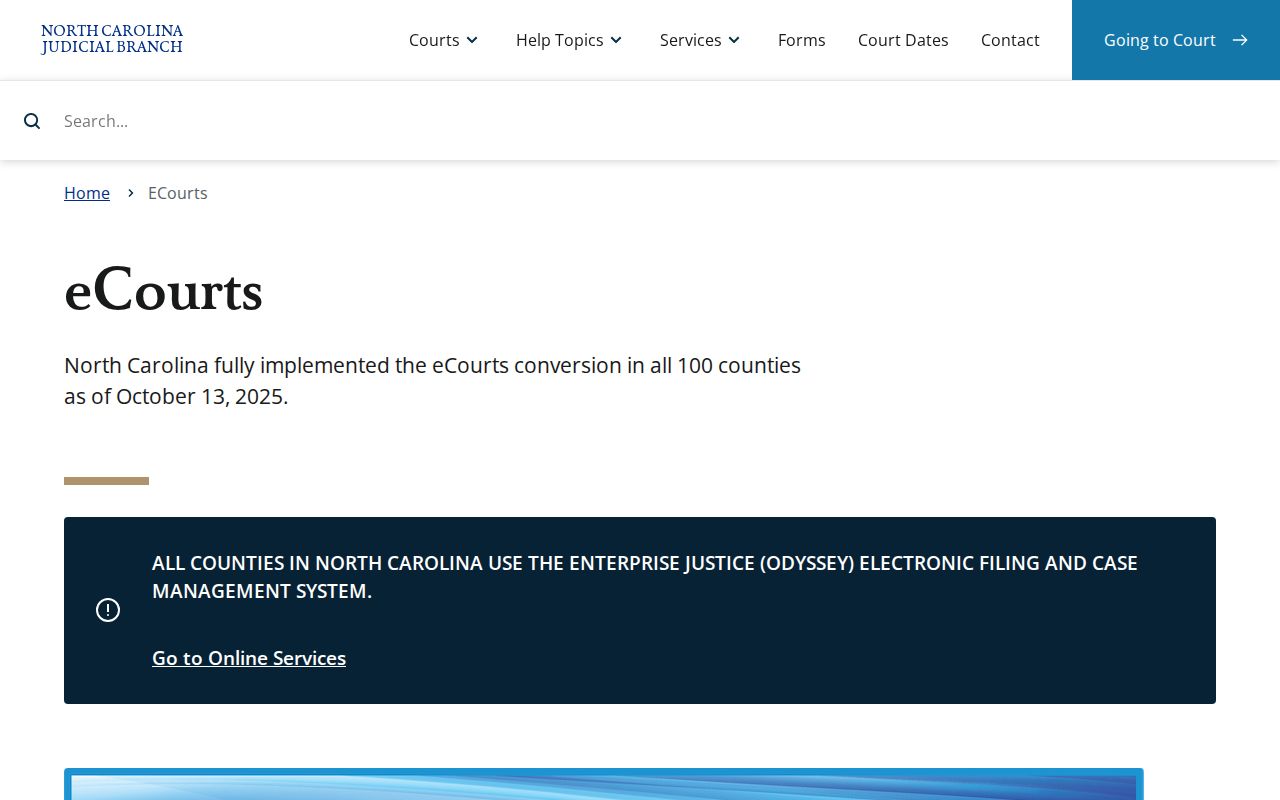
For Cumberland case research, that statewide layer should always be paired with the county filter and a clerk check when the online detail is incomplete.
Inside a Cumberland County Case File
A criminal court file is organized around prosecution and court action. It is not a full police investigation. Searchers should read the file number, division, filing date, charges, events, and judgment together. One case can contain several charges with different results. A dismissed count, guilty plea on another count, and pending count may appear side by side.
| Case Number and Court | Identifies the Cumberland file, location, division, and often the case type. |
|---|---|
| Parties and Attorneys | Names the defendant and public attorney appearances shown in the court record. |
| Charges | Lists offense descriptions, statutes, and the status of each filed count. |
| Docket Events | Records filings, hearings, orders, and register-of-actions dates. |
| Disposition | Shows the outcome of each charge, such as dismissal, acquittal, or conviction. |
| Judgment and Sentence | States the court's final order, punishment, costs, and public conditions when applicable. |
Portal information can help locate these fields, but a certified copy comes from the Cumberland clerk. A state fingerprint-supported rap sheet has a different purpose. It links arrest cycles and reported dispositions under the North Carolina State Bureau of Investigation.
Cumberland Case Dispositions by Charge
Read every charge on its own line. “Disposition” means the recorded outcome of a charge or case. A dismissal ends prosecution on that count without a conviction. An acquittal is a not-guilty result after adjudication. A conviction means guilt was established by plea or decision. A sentence is the order imposed after conviction. Those terms answer separate questions.
- Arraignment
- The stage when charges and a plea are formally addressed.
- Indictment
- A grand jury's formal felony accusation, often called a true bill.
- Dismissal
- Prosecution ended without a conviction on that charge.
- Trial de novo
- A new Superior Court trial after an appeal from a District Court misdemeanor result.
- Judgment
- The court's formal decision and order after the case outcome.
A person-search result is also not identity proof. Match the case number, division, dates, and other public facts. Similar names and spelling changes can place unrelated files in the same result list.
How a Criminal Case Moves
A Cumberland County case may start with an arrest or citation, then move before a magistrate for initial process and a release decision. District Court handles misdemeanor cases and early felony steps. A felony that proceeds by indictment moves to Superior Court. Arraignment and pretrial work follow, then a plea or trial, disposition, and any sentence. Appeals can add another court record.
Case flow: Charges Filed › Arraignment › Pretrial › Plea or Trial › Disposition › Sentencing
Cumberland County also lists Adult Treatment Court, Veterans Treatment Court, DWI Treatment Court, Youth Treatment Court, and Family Treatment Court. Eligibility and record effects depend on the specific program and court order. Participation should not be read into a docket unless the file supports it.
Missing Cumberland Court Case Images
A missing online image does not mean the Cumberland County court record does not exist. First note the file number and every visible event. Next use a courthouse self-service terminal, which can search criminal cases by defendant name, case number, or victim and witness name. Then ask the clerk to inspect the paper case file or locate an archived item. Copies carry the current statutory fee, and the clerk can explain certification.
The Judicial Branch record-access instructions distinguish Portal results, courthouse terminals, paper files, and police records. This is useful because the clerk does not hold the complete police investigative file. The arresting agency remains the right custodian for that report.
The official record-access page is captured below to show the available routes. It anchors the practical fallback from remote search to courthouse inspection.
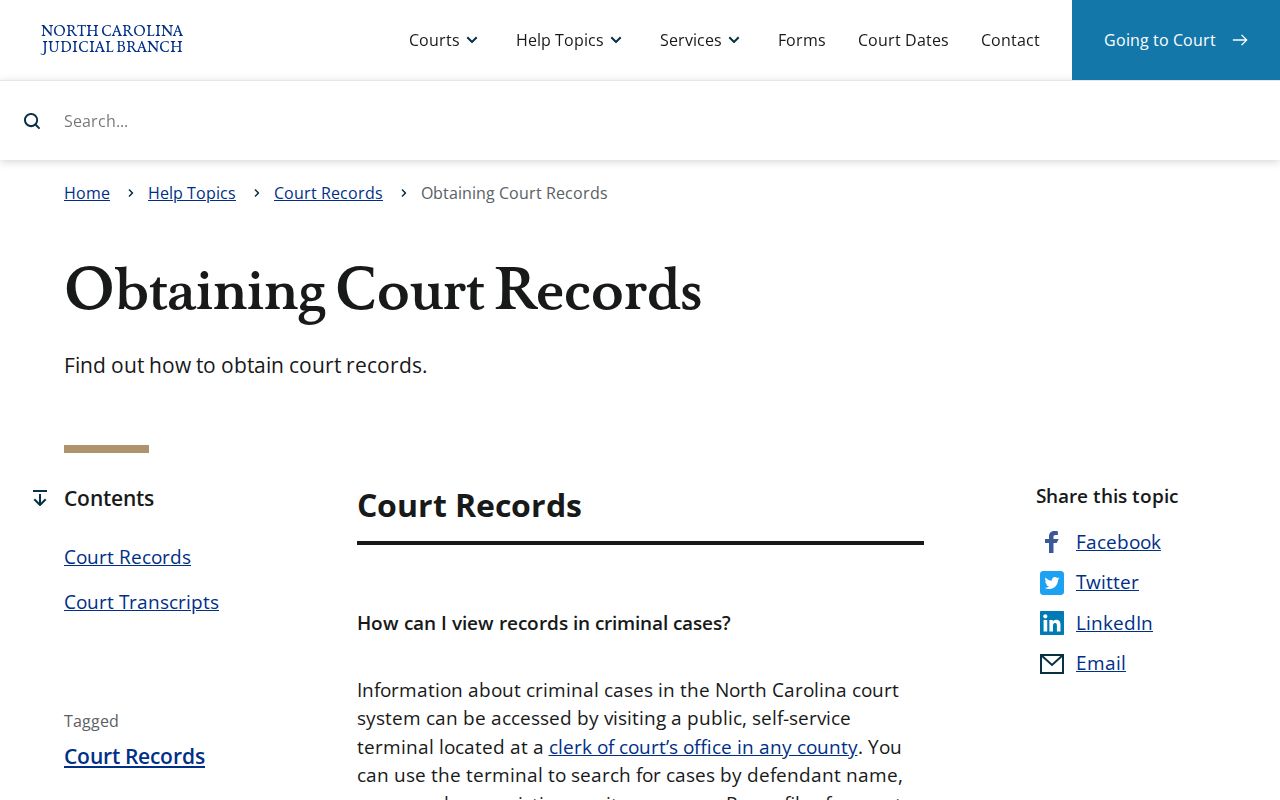
Keep the file number through each step. It is the most reliable bridge between a Portal result and the clerk's paper or certified record.
Cumberland eCourts Kiosk Milestone
In June 2025, the North Carolina Judicial Branch named Cumberland among eight counties receiving public eCourts kiosks with scanners, printers, and payment services. Statewide conversion finished in October 2025. The kiosk therefore adds an onsite digital route without changing who keeps the official criminal court file.
The Cumberland County court services page is the best place to confirm current local access before visiting. The official county page is shown below because it brings together calendars, forms, and local court contacts.
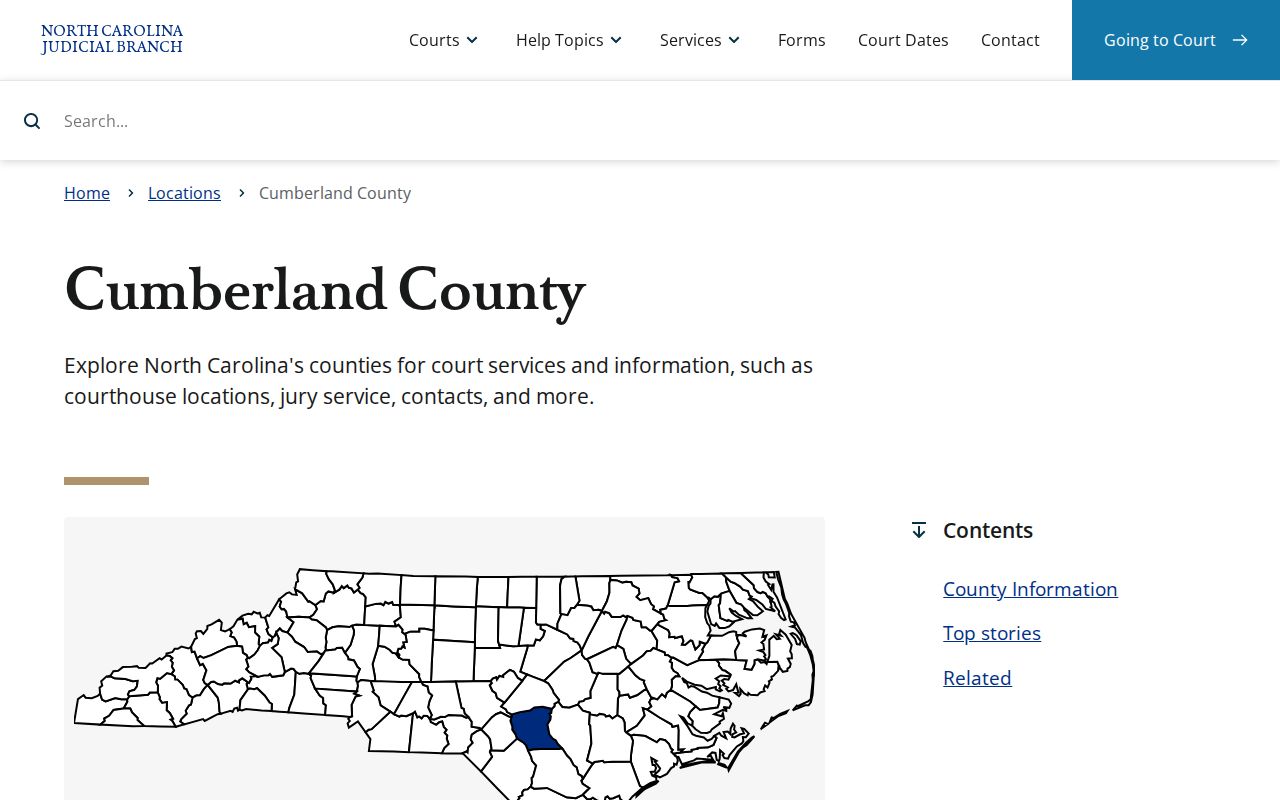
The courthouse resource can solve a remote-search problem, but it does not turn Portal into a certified background check. For an official Cumberland clerk criminal-record search or certification, contact the clerk. The Judicial Branch lists that service at $25.
Case Record Access & Restrictions
North Carolina law generally permits inspection of clerk records under G.S. 7A-109, subject to other confidentiality rules. Portal does not make sealed, expunged, juvenile, protected victim, minor, or personal-identifier data public. Redactions can make the online view less complete than the public portion available through the clerk, while some records remain restricted in every public channel.
If a case should have been expunged but still appears, verify the actual order with the Cumberland clerk. North Carolina uses “expunction” for statutory removal from public effect or access. Some government indexes and authorized uses may remain under Article 5. A missing case can also reflect spelling, an old paper file, a confidential status, or a data lag. Do not guess which explanation applies.
The clerk's criminal desk is the final access point for certification and questions about a file that does not appear online.
Cumberland Clerk of Superior Court
Judge E. Maurice Braswell Cumberland County Courthouse
117 Dick Street
Fayetteville, NC 28301
910-475-3000
Monday through Friday, 8:00 a.m. to 5:00 p.m.