
Cumberland County Arrest History
An arrest in Cumberland County creates several records. The arresting agency writes its incident or arrest documentation. The Cumberland County Detention Center creates a booking entry when a person enters custody. A magistrate records release terms and a first court date. If prosecutors file charges, the Clerk of Superior Court opens the court case. Fingerprints may also start an arrest cycle in the North Carolina State Bureau of Investigation's Computerized Criminal History database.
Cumberland County Sheriff deputies, Fayetteville Police, Hope Mills Police, Spring Lake Police, State Highway Patrol, campus agencies, and military or federal officers can all create arrest-related records in this area. First identify the agency. Fort Bragg, Pope Army Airfield, and several campuses make that step more important here than in a county served by one main police force.
Three Cumberland Arrest Record Custodians
One event can produce records under three main custodians. The officer's agency keeps the report. CCSO keeps the booking and custody entry when the person is admitted to the county jail. The clerk keeps the prosecution after charges are filed. The adjacent Dick Street buildings do not merge those roles: court files are at the courthouse side, while sheriff and jail records are at the Law Enforcement Center.
| Question | Record Custodian | Best Channel |
|---|---|---|
| What did the officer report? | Arresting agency | Agency report page, counter, or public-record request |
| Is the person in county custody? | Cumberland Detention Center | Active Inmate Lookup or jail information desk |
| What charges were filed? | Clerk of Superior Court | eCourts Portal, terminal, or paper file |
| What is on my statewide record? | NCSBI CIIS | Fingerprint-based Right to Review |
A jail entry can be current while no court case is visible. A court charge can differ from the charge first named by police. Compare the sources instead of forcing one record to answer every question.
Looking Up Cumberland County Arrests
No single public search produces a complete Cumberland County arrest history. Use the official route tied to the record sought. Current custody is a jail question. Arrest facts and an officer's narrative begin with the arresting agency. The filed charge and outcome are court questions. The NCSBI personal review is the statewide fingerprint-supported route for one's own record.
- Identify the arresting agency and allow for processing. Check CCSO Active Inmate Lookup for current county custody.
- Call the jail information desk at 910-672-5630 or 910-672-5622 when custody is urgent or the online result is unclear.
- Request public arrest facts or the available report from the creating agency. Use the CCSO Reports Center for a sheriff event, or the police department that made a city arrest.
- Search Cumberland County in eCourts Portal, then use the clerk terminal or paper file to connect the arrest to filed charges and an outcome.
- For your own statewide fingerprint-supported history, follow the NCSBI Right to Review process. A formal Chapter 132 request can seek a well-described existing county or police record when routine channels fail.
Include the incident or report number when known. Otherwise give the date, time, place, names involved, investigating officer if known, desired record, format, and contact details. Ask the office about any identification, copy cost, or certification rule because CCSO does not publish one universal report fee or guaranteed turnaround.
Cumberland Arrest Booking Time Gap
CCSO warns that police pre-booking can take four or more hours. Jail intake can take another four to eight hours. A person may therefore be in the arrest process without appearing in Active Inmate Lookup. That delay is not proof of release, a mistaken name, or the absence of an arrest.
Intake includes searches, private medical screening, a second needs and capability screen, mental-health screening, identity work, warrant checks, a photograph, fingerprints, and data entry. A judicial official sets bail and a court date. Classification and housing follow if release is not immediate. Intoxicated people may remain held until safe release, which can extend past 24 hours.
The official Cumberland County Detention Center page describes the local booking process and its service routes.
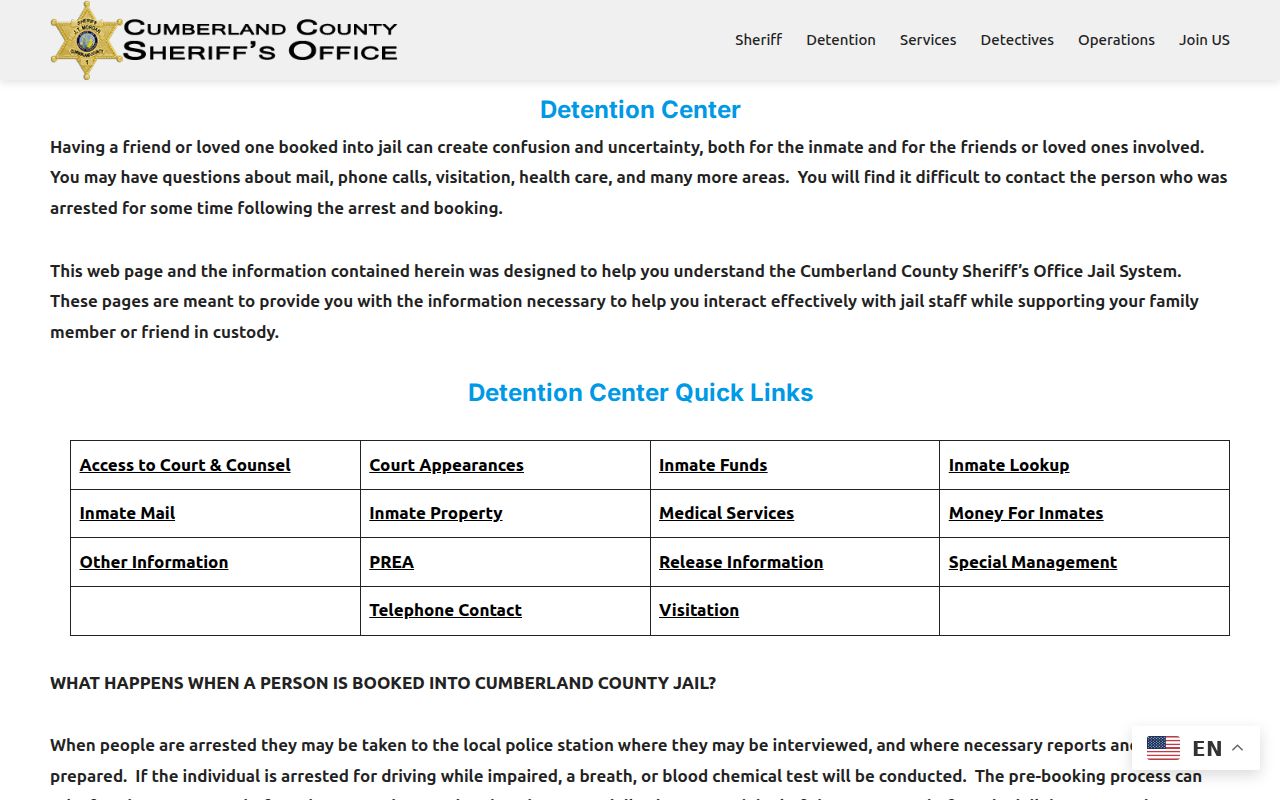
This intake detail explains why the jail roster is a delayed custody tool, not a real-time feed of every arrest in Cumberland County.
Inside a Cumberland County Arrest Record
Public arrest facts can include the time, date, location, and nature of a reported violation; the arrested person's name, sex, age, address, and alleged violation; and the circumstances of arrest. G.S. 132-1.4 also identifies certain facts about resistance, weapons, pursuit, seized items, and involved law-enforcement personnel. Full witness statements, investigative narratives, evidence details, juvenile data, medical information, and protected identifiers may be withheld or redacted.
| Booking or Inmate Number | A jail identifier that is stronger than a name for matching the custody entry. |
|---|---|
| Booking Date and Time | Shows when jail intake was recorded, not necessarily the exact arrest time. |
| Arresting Agency | Identifies which office should hold the incident or arrest report. |
| Charge | States the allegation at booking; the prosecutor's filed charge can differ. |
| Bond and Court Date | Reflects the judicial official's release terms and next listed appearance. |
| Booking Photograph | May appear if the live official interface publishes it; release depends on current agency practice and law. |
| Custody or Release Status | Shows the current or last published jail status where available. |
Identity must be checked with more than a name. When possible, compare the exact identifier, booking date, agency, case number, and court file. The live CCSO interface controls which profile fields appear.
Cumberland Arrest Reports by Agency
For a Cumberland County Sheriff's Office event, begin at the CCSO Reports Center, call 910-323-1500, visit 131 Dick Street, or submit a specific request under the North Carolina Public Records Law. Fayetteville Police uses its Police Reports and public-record request channel. Hope Mills Police routes accident, arrest, and incident reports through Evidence & Records in the front lobby at 5788 Rockfish Road. Spring Lake uses its Police and Town Clerk request process, including a signed and dated description.
State Highway Patrol, university police, and Fort Bragg law enforcement keep their own originating records. A local jail or court result may still exist if the person was booked or charged in Cumberland County. Start with jurisdiction, then follow the event into jail and court systems.
CCSO Reports Center
Cumberland County Law Enforcement Center
131 Dick Street
Fayetteville, NC 28301
910-323-1500
Confirm current counter access before visiting.
The creating agency can release the public portion of its record. It cannot certify the final court disposition, which belongs in the Cumberland County criminal court case.
Booking Logs and Recent Arrests
CCSO Active Inmate Lookup is the official online route for people in current county custody after intake. It may accept a name and, where exposed, a booking or inmate identifier. Results can link to a profile with current booking and charge information. The embedded vendor interface can change, so its live labels control.
The lookup is not a full Cumberland County arrest-history database. An entry may not appear during pre-booking or intake. It may also disappear after release, transfer, or another status change. Other reasons for no result include a citation without custody, booking in another jurisdiction, a spelling variation, or an arrest by an agency whose person never entered the county jail.
CCSO does not advertise an authenticated sheriff app with an app-only inmate or warrant tool on its principal official pages. Avoid similarly named commercial apps. Use the sheriff's official web page and direct phone lines.
Cumberland Arrest Release File Review
Cumberland release staff review each file before discharge. Release can follow bond, a court order, completion of a sentence, payment of a fine or cost, release of another agency's hold, or lawful transfer. Processing can occur day or night, and records are handled in order. Sentenced releases are generally processed from 6:00 a.m. to 9:00 p.m. unless a court directs otherwise. NCDAC transfer timing is not public.
If someone no longer appears in the active search, call the jail information desk and then check eCourts for a filed Cumberland case. A released person may still have a pending court date. A transfer to state custody belongs in NCDAC Public Offender Search, which is separate from the county jail roster.
Jail procedures extend beyond the booking screen. The official CCSO visitation page illustrates how current custody services use their own rules, schedules, and contacts.
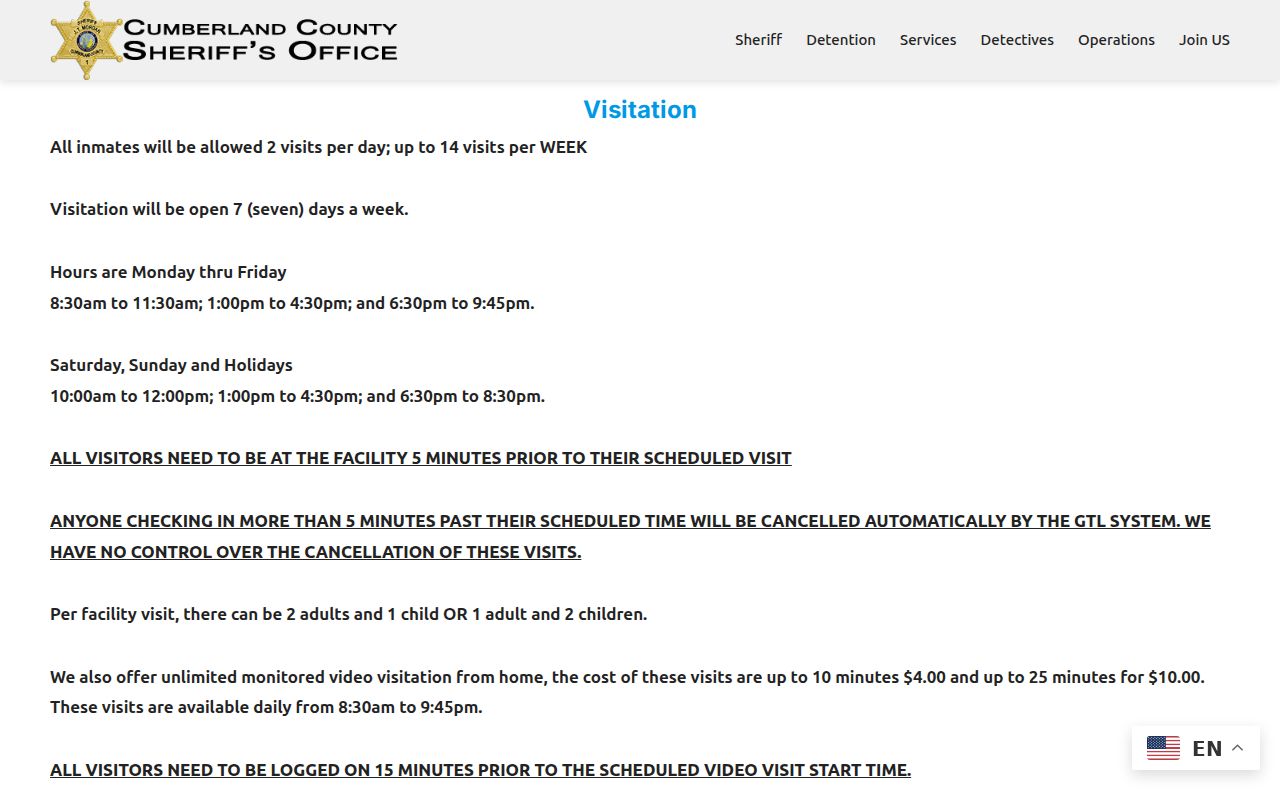
The custody system's separate service pages reinforce a key limit: an active jail profile is about present detention, not a complete past arrest record.
Cumberland Arrest Facts Under State Law
The public arrest provisions in G.S. 132-1.4 separate listed public facts from the broader criminal investigation. Ask for the exact existing record and give enough detail to locate it. An agency does not have to create a new analysis. Redaction can protect witnesses, victims, minors, medical data, Social Security numbers, intelligence, and evidence details.
A mugshot is a law-enforcement photograph within an investigative or booking system. Whether the official live interface shows one depends on agency practice and law. Do not use commercial mugshot sites. The reliable task is to locate the official record and confirm its scope, not collect arrest images.
Arrests Are Not Convictions
An arrest record shows an allegation and custody event. A conviction record shows that guilt was established in court by plea or adjudication. The documents have different custodians and can reach different outcomes. A release, dismissal, acquittal, or charge change does not rewrite the original booking entry by itself.
| Point | Arrest Record | Conviction Record |
|---|---|---|
| Created by | Arresting agency and jail | District or Superior Court |
| Shows | Arrest facts, booking, allegation, bond, and custody | Filed charge, judgment, and sentence |
| Kept by | Agency records unit and CCSO jail system | Cumberland Clerk and reported state history |
| Possible outcome | Release, transfer, no filed case, or later court action | Dismissal, acquittal, conviction, appeal, or lawful expunction |
Note: An arrest is not proof of guilt; verify each filed charge and disposition in the official Cumberland court record.
If a dismissed or not-guilty arrest still appears, review G.S. 15A-146 and verify any expunction order with the clerk. After processing time, a person can use NCSBI Right to Review and its exception procedure to challenge stale or incorrect fingerprint-supported state data.